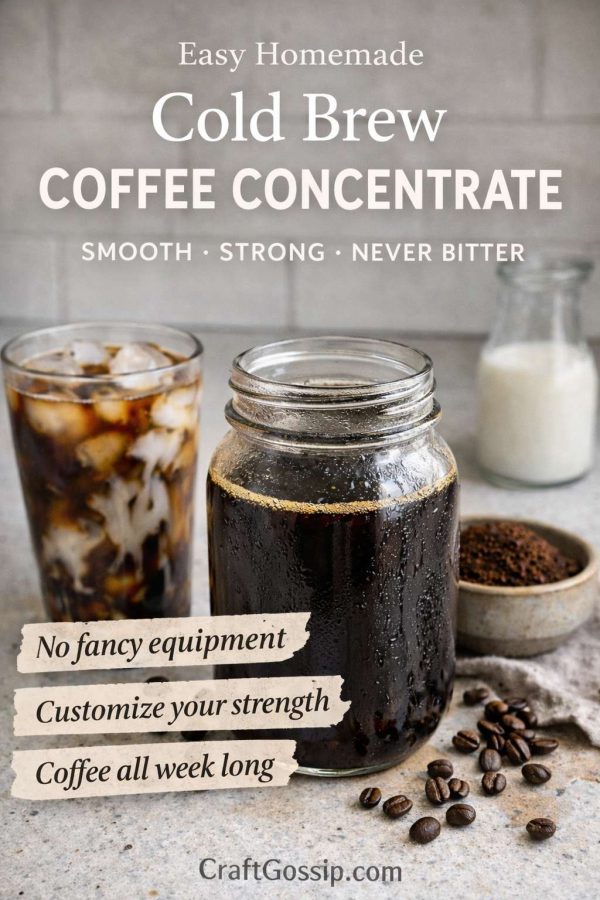
If you love iced coffee but hate that watered-down, slightly bitter taste you sometimes get when hot coffee is poured over ice, learning how to make cold brew coffee at home is one of those little kitchen tricks you will wonder why you didn’t try sooner.
Cold brew is ridiculously easy.
There is no espresso machine involved, no complicated pouring technique, and thankfully no need to stand over anything at 6 am pretending you are a barista.
You simply combine coarsely ground coffee and water, leave it to steep, strain it, and pop it in the fridge.
The part that tends to confuse people is the ratio.
Should it be 1:4? 1:8? 1:15?
The answer depends on whether you want cold brew concentrate or a cold brew that is ready to drink straight from the jar.
So I’m covering both.
Quick Cold Brew Coffee Recipe
For anyone who has landed here with coffee grounds already sitting on the kitchen bench, this is the short version.
Cold Brew Concentrate
Use:
- 1 part coarsely ground coffee
- 4 parts filtered water
- Steep for approximately 12–18 hours
- Strain thoroughly
- Dilute with water or milk before drinking
For an easy household batch:
- 1 cup coarsely ground coffee
- 4 cups cold filtered water
Ready-to-Drink Cold Brew
For a lighter cold brew you can pour directly over ice, use approximately:
- 1 part coffee
- 8–12 parts water
You can adjust this depending on your beans and how strong you like your coffee.
And that really is the lovely thing about cold brew. There isn’t one sacred coffee ratio handed down by the caffeine gods. You can tweak it.
What Is Cold Brew Coffee?
Cold brew coffee is made by steeping ground coffee in cold or room-temperature water for several hours rather than extracting the coffee quickly with hot water.
Once brewed, the grounds are filtered out.
The result is generally a smooth, mellow coffee with less of the sharp flavour people sometimes associate with hot-brewed coffee.
Despite the name, cold brew doesn’t necessarily have to be brewed inside the refrigerator.
It can be steeped at room temperature and refrigerated once strained, although I generally prefer the fridge method because it fits neatly into my usual make-it-tonight-and-deal-with-it-tomorrow approach to cooking.
Cold Brew Coffee vs Cold Brew Concentrate
These terms get used interchangeably, but they aren’t quite the same thing.
Ready-to-drink cold brew
Ready-to-drink cold brew contains considerably more water and can usually be poured straight over ice.
Cold brew concentrate
Cold brew concentrate uses much more coffee in relation to the water.
It creates a strong coffee base designed to be diluted later with:
- water
- milk
- oat milk
- almond milk
- sparkling water
- cream
- flavoured syrups
I prefer making concentrate because it gives you far more flexibility.
One person can make theirs strong and black while somebody else can turn the same batch into a creamy vanilla iced coffee.
No arguments over the coffee jug required.
The Best Cold Brew Coffee Ratio
This is probably the most searched cold brew question, and unfortunately it is also where recipes become unnecessarily confusing.
The easiest way to understand a cold brew coffee ratio is simply:
coffee : water
So a 1:4 ratio means one part coffee to four parts water.
Cold Brew Ratio Guide
| Style | Coffee-to-Water Ratio | Best For |
|---|---|---|
| Very strong concentrate | 1:4 | Iced lattes, milk drinks, desserts |
| Standard concentrate | 1:5–1:6 | Diluting with water or milk |
| Strong ready-to-drink | 1:8 | Drinking over ice |
| Lighter cold brew | 1:10–1:12 | Black cold brew |
You will see different ratios recommended by different coffee makers because coffee beans, grind size, steeping temperature and personal taste all change the final result.
For home use, I find 1:4 is an excellent starting point for concentrate because it is easy to remember and gives you plenty of flexibility when serving.
My Easy Cold Brew Coffee Concentrate Recipe
Ingredients
- 1 cup coarsely ground coffee
- 4 cups cold filtered water
Equipment
You don’t need a dedicated cold brew machine.
You can make this with:
- a large glass jar or jug
- a spoon
- fine mesh strainer
- coffee filter, clean muslin or nut-milk bag
- airtight bottle or jar for storage
A French press also works beautifully.
If you make cold brew regularly, a dedicated cold brew pitcher with a removable filter is handy, but it is definitely a convenience rather than a necessity.
How to Make Cold Brew Coffee Step by Step
Step 1: Grind the Coffee Coarsely
Your coffee should look roughly like coarse raw sugar or coarse sea salt.
This matters more than people realise.
Coffee that is ground too finely can make cold brew cloudy, muddy and more difficult to strain.
Fine grounds also extract faster, which can contribute to an unpleasant bitter or harsh flavour.
If you don’t own a grinder, ask for coffee ground for a French press or coarse filter brewing.
Step 2: Add the Coffee and Water
Place your ground coffee in a large jar or jug.
Pour over the cold filtered water.
Gently stir just enough to make sure all the coffee grounds are wet.
Don’t attack it with a spoon like you’re whipping cream. We are steeping coffee, not punishing it.
Step 3: Cover and Steep
Cover your container.
Place it in the refrigerator for approximately 12–18 hours.
You can steep it for up to 24 hours, but longer is not necessarily better.
My preferred starting point is around 16–18 hours.
Make it after dinner and strain it the following morning or around lunchtime the next day.
Step 4: Strain the Coffee
First strain the mixture through a fine mesh sieve to remove the larger grounds.
For a cleaner cold brew, strain it again through:
- a paper coffee filter
- clean muslin
- cheesecloth
- a nut-milk bag
The second filtration makes a noticeable difference, particularly if you dislike sediment collecting at the bottom of your glass.
And don’t squeeze every last drop through the filter.
It is tempting—I know—but pressing the grounds can push fine particles into the coffee and make it cloudy.
Step 5: Refrigerate
Pour your finished cold brew concentrate into a clean airtight glass bottle or jar.
Keep it refrigerated.
For best flavour, I generally aim to use homemade cold brew within about a week.
How Long Should You Steep Cold Brew Coffee?
For most home cold brew recipes, 12–18 hours is a good starting point.
There isn’t a magical moment at exactly 16 hours and 37 minutes when your coffee suddenly becomes perfect.
Think of steeping time as one of several variables.
12 hours
Usually lighter and milder.
16–18 hours
A good middle ground for balanced flavour and strength.
20–24 hours
Stronger extraction, although some coffees can begin tasting woody, harsh or overly heavy.
If your first batch is too bitter, don’t immediately reduce the amount of coffee.
Try shortening the steep time or using a slightly coarser grind first.
Should Cold Brew Steep in the Fridge or on the Counter?
You can find recipes using both methods.
Room-temperature water generally extracts coffee faster than refrigerated water, so steeping time may need to be shorter.
For beginners, I prefer refrigerating the mixture because it is convenient and easy to repeat consistently.
It also means you aren’t staring at a giant jar of mysterious brown sludge sitting on your kitchen bench wondering whether someone forgot to wash it.
What Grind Size Is Best for Cold Brew?
Use a coarse grind.
Think:
- coarse sea salt
- cracked pepper
- raw sugar
Avoid espresso-fine coffee.
The finer the coffee, the more difficult it becomes to filter cleanly.
Coarse coffee makes cold brew easier to strain and generally produces the smoother result most of us are looking for.
What Coffee Beans Are Best for Cold Brew?
You do not need an expensive specialty coffee to make good cold brew.
I usually recommend starting with medium or medium-dark roast beans, particularly if you plan to add milk.
Coffee with chocolate, caramel and nutty flavour notes tends to work beautifully in cold brew.
If you prefer drinking your cold brew black, lighter and fruitier beans can also be interesting because cold brewing can bring out very different flavours compared with hot brewing.
The useful rule here is not “buy the most expensive beans.”
It is use coffee you already enjoy drinking.
Cold brewing doesn’t magically rescue stale coffee.
Fresh beans still matter.
Does Filtered Water Matter?
Yes.
Coffee is mostly water, so unpleasant-tasting water will still make unpleasant-tasting coffee.
You don’t need exotic bottled water imported from a mountain spring, but if your tap water has a strong chlorine taste or smell, filtered water is worth using.
How to Drink Cold Brew Concentrate
This is the main reason I make concentrate rather than ready-to-drink cold brew.
One bottle gives you lots of options.
Classic Iced Cold Brew
Try:
- 1 part cold brew concentrate
- 1 part cold water
- plenty of ice
Adjust from there.
Cold Brew With Milk
Try:
- 1 part concentrate
- 1–2 parts milk
Use dairy milk, oat milk, almond milk or whichever milk you normally use.
Vanilla Cold Brew
Add:
- cold brew concentrate
- milk or water
- vanilla syrup
- ice
Top it with our easy homemade cold foam if you want the full coffee-shop treatment without actually leaving the house.
Sparkling Cold Brew
This sounds slightly odd until you try it.
Combine:
- cold brew concentrate
- sparkling water
- plenty of ice
A slice of orange can also be surprisingly good with certain coffees.
Hot Coffee
Yes, you can drink cold brew hot.
Combine concentrate with hot water rather than brewing another coffee from scratch.
This makes your fridge stash useful all year instead of just during summer.
How Strong Is Cold Brew?
Cold brew can taste incredibly strong, particularly when you make a concentrate, but strength and caffeine aren’t exactly the same thing.
The total caffeine in your glass depends on several factors, including:
- the amount of coffee used
- coffee variety
- serving size
- brewing ratio
- steeping time
- how much you dilute the finished concentrate
This is also why comparing one glass of cold brew with one espresso shot can be misleading.
A concentrated cold brew may be diluted heavily before you drink it, while another person may pour theirs almost straight.
If you are sensitive to caffeine, treat homemade concentrate as exactly that—a concentrate—and dilute accordingly.
Why Is My Cold Brew Bitter?
If your cold brew tastes harsh or bitter, check these things first.
Your coffee was ground too finely
This is one of the most common problems.
Try a coarser grind next time.
You steeped it too long
Longer doesn’t automatically mean better.
Try reducing your brew time.
Your beans are very dark
Very dark roasted beans can produce a heavier roasted flavour that becomes too intense when concentrated.
Try a medium roast.
You’re drinking concentrate undiluted
This sounds obvious, but cold brew concentrate is intentionally strong.
Try adding more water or milk before changing the recipe.
Why Does My Cold Brew Taste Weak?
If your cold brew tastes disappointingly watery:
- increase the amount of coffee
- use a stronger ratio
- steep slightly longer
- check that all the grounds were fully wet
- make sure your coffee isn’t ground extremely coarse
If you’re making ready-to-drink cold brew and adding a huge glassful of melting ice, remember that the ice is also diluting it.
That sneaky ice gets us every time.
Why Is My Cold Brew Cloudy?
A little cloudiness isn’t necessarily a problem, but excessive sediment usually means very fine coffee particles have made it through your filter.
Try:
- grinding coarser
- filtering twice
- using a paper filter for the second pass
- allowing the coffee to drain rather than squeezing the grounds
Why Does My Cold Brew Taste Sour?
Sourness can suggest the coffee hasn’t extracted enough.
Try:
- steeping longer
- grinding slightly finer
- using a stronger coffee-to-water ratio
Remember that some lighter coffees naturally have brighter, fruity acidity, so not every tart note means something has gone wrong.
Cold Brew vs Iced Coffee
This is another question that causes a surprising amount of coffee confusion.
Iced Coffee
Iced coffee is usually hot-brewed coffee that is cooled and served over ice.
Cold Brew
Cold brew is brewed using cold or room-temperature water over many hours.
They can both be served cold, but they are completely different brewing methods.
Cold brew generally tastes smoother and rounder, while iced coffee retains more of the flavour characteristics created during hot extraction.
Neither is automatically better.
But if you want something you can prepare in a big batch and grab from the fridge all week, cold brew wins for convenience.
Cold Brew vs Cold Drip Coffee
Cold brew and cold drip aren’t quite the same thing either.
Traditional cold brew uses immersion brewing.
That means the grounds sit submerged in water before being filtered.
Cold drip coffee slowly passes water through coffee grounds using a drip tower or similar brewing system.
Those beautiful glass cold-drip towers do look impressive on a café counter, but you absolutely do not need one to make great cold coffee at home.
A jar still works.
Sometimes the jam jar wins.
What Is Nitro Cold Brew?
Nitro cold brew is cold brew coffee infused with nitrogen.
The nitrogen creates the creamy texture and cascading appearance you might have seen when nitro coffee is poured from a tap.
It can make black coffee feel surprisingly creamy even without adding milk.
Home nitro systems do exist, but for everyday cold brew they are firmly in the “fun extra” category rather than something you need.
Can You Make Cold Brew in a French Press?
Absolutely.
A French press is actually one of the easiest cold brew methods.
Add your coffee and water directly to the press, steep, then slowly push down the plunger.
For an especially clean drink, run the coffee through a paper filter afterwards.
Don’t press aggressively because this can disturb the sediment and send fine particles back into your coffee.
Can You Make Cold Brew Without a Coffee Grinder?
Yes.
Buy coffee that has already been coarsely ground for French press.
Avoid standard supermarket espresso-ground coffee if possible because it is generally finer than ideal for cold brew.
If you’re buying beans from a café or roaster, simply tell them you’re making cold brew and ask for a coarse grind.
How Long Does Homemade Cold Brew Last?
I prefer to drink homemade cold brew within approximately 7 days for the best flavour.
Store it:
- refrigerated
- in a clean airtight container
- preferably in glass
Some cold brew can remain usable for longer, but coffee flavour begins changing after brewing and fresh is usually nicer.
If it smells or tastes off, discard it.
Can You Freeze Cold Brew?
Yes, and this is one of my favourite tricks.
Pour leftover cold brew or concentrate into an ice-cube tray.
Once frozen, add the coffee cubes to iced coffee instead of ordinary ice.
As they melt, your drink becomes more coffee-flavoured rather than slowly turning into vaguely coffee-scented water.
They are also brilliant in:
- coffee smoothies
- frappes
- chocolate milkshakes
- iced lattes
Ways to Use Leftover Cold Brew Concentrate
Cold brew isn’t limited to drinks.
Try adding a small amount to:
- tiramisu
- chocolate cake
- brownies
- chocolate frosting
- whipped cream
- coffee smoothies
- homemade coffee ice cream
You can also use it in frozen coffee cocktails or coffee slushies.
This is why I never worry too much about making a large batch. It tends to disappear.
Cold Brew Coffee Cheat Sheet
If you only remember a few things from this guide, make them these:
Grind: coarse
Concentrate ratio: start around 1:4
Ready-to-drink ratio: start around 1:8 to 1:12
Steep: approximately 12–18 hours
Water: filtered if possible
Filter: twice for smoother coffee
Storage: refrigerated in an airtight container
Best used: within about one week
Frequently Asked Questions About Cold Brew Coffee
What is the best ratio for cold brew coffee?
For concentrate, start around 1 part coffee to 4 parts water. For ready-to-drink cold brew, approximately 1:8 to 1:12 is a useful starting range.
How long should cold brew steep?
Around 12–18 hours works well for most home cold brew recipes. Adjust the time depending on grind size, temperature, beans and personal taste.
Can you steep cold brew for 24 hours?
Yes, although more time doesn’t always mean better coffee. Some batches can become woody or harsh when steeped too long.
Do you have to refrigerate cold brew while brewing?
No. Cold brew can be steeped at room temperature or in the refrigerator. Room-temperature extraction generally happens faster.
Can I use regular ground coffee for cold brew?
You can, but coarse coffee is much easier to filter and generally produces a cleaner result.
Is cold brew the same as iced coffee?
No. Iced coffee is usually brewed hot and then chilled. Cold brew is extracted slowly using cold or room-temperature water.
Do I need a cold brew maker?
No. A large jar, sieve and coffee filter are enough.
Can I drink cold brew concentrate straight?
You can, but concentrate is intentionally very strong. Most people prefer diluting it with water or milk.
What is the best coffee for cold brew?
Medium and medium-dark roasts are good starting points, especially for milk-based drinks. Ultimately, use beans with flavours you already enjoy.
Can cold brew be served hot?
Yes. Add hot water to cold brew concentrate for a quick smooth hot coffee.
My Favourite Way to Make It
After experimenting with cold brew, I keep coming back to the simple method.
Coarse coffee.
Filtered water.
About 16–18 hours in the fridge.
Strain it properly.
Done.
You can buy special brewers, filters and all sorts of clever coffee gadgets—and if you make cold brew constantly, some of them are genuinely handy—but don’t let equipment stop you from trying it.
Start with a jar.
Once you know how strong you like it, you can adjust your coffee-to-water ratio until you have your perfect batch.
And once there is a bottle of homemade cold brew concentrate sitting in the fridge next to the milk, buying a café iced coffee suddenly becomes a lot harder to justify.