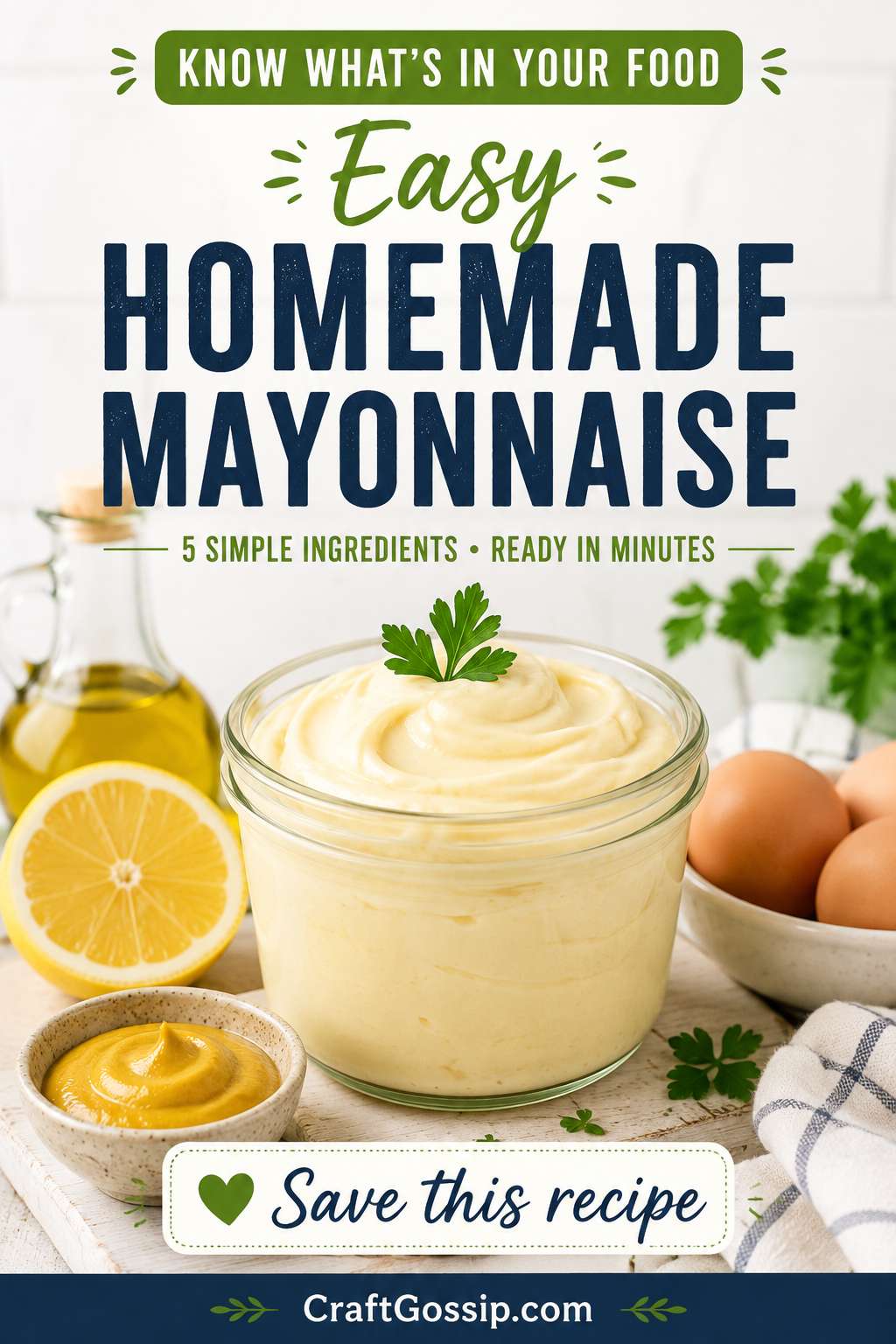
I’ve become much more interested in knowing what is actually in the food I’m eating.
Not in an obsessive, everything-must-be-made-from-scratch sort of way. I still have convenience foods in my pantry and I’m certainly not standing around churning my own butter on a Tuesday afternoon.
But there are some everyday foods that are so ridiculously easy to make yourself that it’s worth knowing how.
Mayonnaise is one of them.
When you make homemade mayonnaise, there is no ingredient label to decipher because you put every ingredient in the jar yourself.
Egg.
Oil.
Mustard.
Lemon juice or vinegar.
Salt.
That’s basically it.
You choose the oil. You choose the egg. You decide how much salt goes in. You can make it tangier, milder, garlicky, spicy or completely plain.
And with a stick blender, the whole thing takes only a couple of minutes.
Why Make Your Own Mayonnaise?
For me, the biggest advantage isn’t actually the flavour—although fresh mayonnaise is delicious.
It’s ingredient control.
Commercial mayonnaise varies enormously between brands. Depending on what you buy, the ingredient list may include different oils, sugars or sweeteners, preservatives, stabilisers, thickeners and flavourings.
That doesn’t automatically make supermarket mayonnaise “bad.”
It simply means that when you make it yourself, you know exactly what you’re eating.
Homemade mayo lets you choose:
- which oil you use
- the type of egg
- how much salt goes in
- whether you add sugar
- how acidic or tangy it tastes
- whether you add herbs, garlic or spices
If you’re beginning to cook more foods from basic ingredients, mayonnaise is a brilliant little recipe to learn because the result feels far more impressive than the amount of work involved.
Five Simple Ingredients
You don’t need a cupboard full of specialist ingredients.
For approximately one cup of homemade mayonnaise you’ll need:
- 1 large pasteurized egg
- 1 tablespoon Dijon mustard (my favorite brand)
- 1 tablespoon fresh lemon juice or white wine vinegar
- 1/4 teaspoon fine salt
- 1 cup neutral-flavoured oil
That’s your mayonnaise.
No complicated processing and no mystery ingredients.
And because you are making it, you can adapt every one of those ingredients to suit your household.
You Get to Choose the Oil
This is one of the biggest reasons I like making mayonnaise myself.
Oil makes up a large percentage of mayonnaise, yet when we grab a jar from the supermarket we don’t always stop to think about which oil has been used.
At home, the choice is yours.
For a mild mayonnaise, try:
- sunflower oil
- grapeseed oil
- avocado oil My preffered oil, sits well on my stomach too.
- canola oil
- another mild vegetable oil
You can also use some olive oil, although a strongly flavoured extra virgin olive oil can produce a mayonnaise that’s surprisingly bitter once blended.
I usually recommend starting with:
3/4 cup neutral oil + 1/4 cup mild olive oil
Then adjust the ratio next time according to your taste.
That’s really the point of making basic foods yourself.
You aren’t limited to somebody else’s recipe.
You Control the Salt and Sugar Too
If you’re watching how much added sugar or salt is in your food, homemade mayonnaise gives you complete control.
The basic recipe doesn’t need added sugar at all.
You can also begin with a small amount of salt, taste the finished mayonnaise and add more only if it needs it.
It’s a very simple example of something I’ve been appreciating more lately: rather than trying to decode a food label after something has been made, sometimes it’s easier to start with the ingredients yourself.
Homemade Doesn’t Have to Mean Complicated
There’s an unfortunate idea that making food from scratch means spending half your day in the kitchen.
Absolutely not.
I’m interested in homemade food when the effort makes sense.
If something takes three hours, sixteen bowls and leaves the kitchen looking like a cooking competition has taken place, I’m considerably less enthusiastic.
This mayonnaise passes my test.
With an immersion blender, it takes about five minutes.
Add everything to a narrow jar, put the blender at the bottom, blend until the emulsion begins to form and slowly lift the blender through the oil.
Suddenly you have thick homemade mayonnaise.
It’s one of those little kitchen tricks that’s genuinely worth learning.
A Small Change That Makes You Look at Food Differently
Once you start making a few everyday staples yourself, you begin noticing food labels differently.
Not because every packaged ingredient needs to be avoided.
It simply becomes easier to ask:
What is actually in this?
Could I make a simple version myself?
Do I prefer the ingredients I’d choose at home?
Sometimes the answer will still be, “I’m buying the jar.”
And that’s perfectly reasonable.
But when something takes five minutes and five basic ingredients, having the homemade option is rather nice.
Mayonnaise is a very good place to start.